

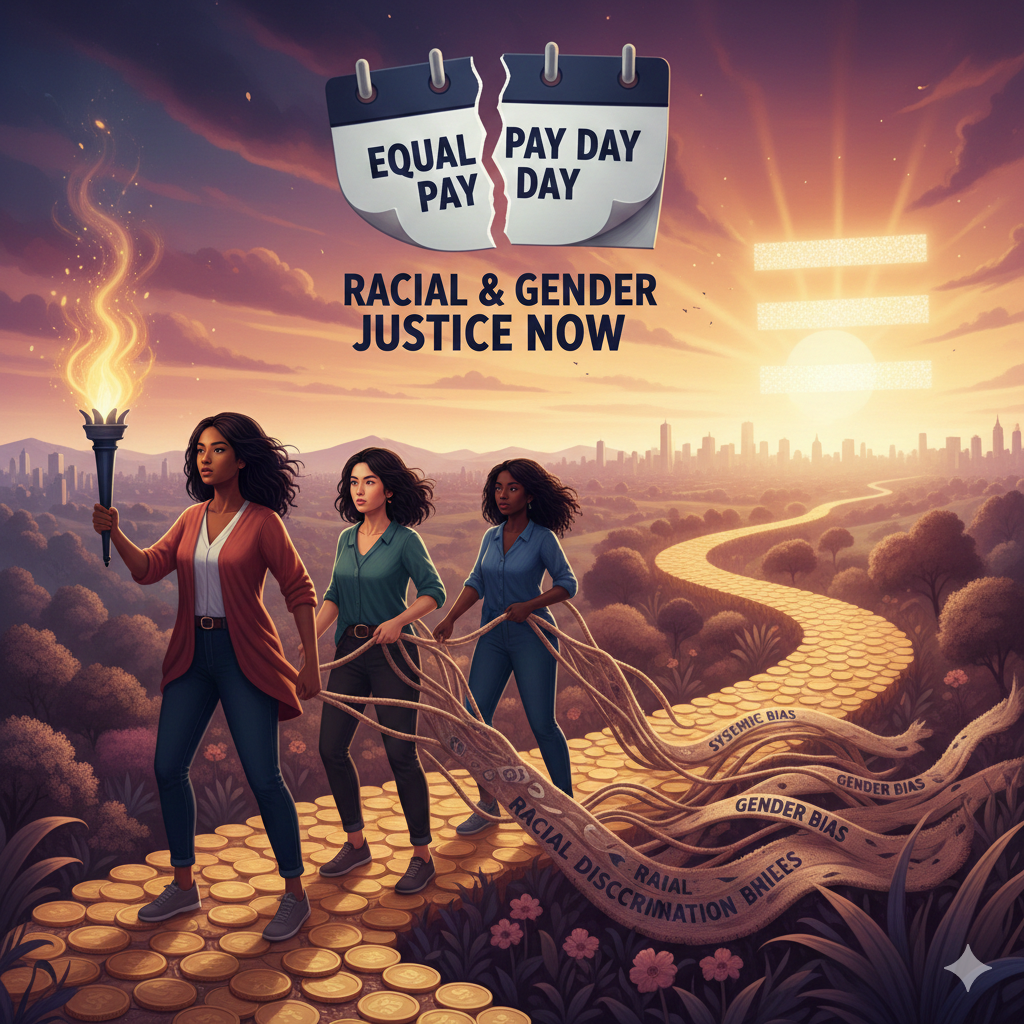
The national observation of Equal Pay Day often masks a deeper, more troubling reality: the wage gap is a complex tapestry woven with threads of sexism and racism. For women of color, the path to pay parity is significantly longer, making the push for economic empowerment an urgent matter of racial and gender justice.
The True Cost of Inequality: Equal Pay Days by Race/Ethnicity
The delayed Equal Pay Days for women of color demonstrate the staggering duration they must work into the new year to earn what a white, non-Hispanic man earned in the previous year.
| Demographic | Equal Pay Day (2023/2024 Data) | Cents Earned per $1 (White, Non-Hispanic Man) | Lifetime Earnings Loss (Approx. 40-Year Career) |
| Black Women | July 27 | $\approx \mathbf{6 7}$ cents (2023) | Over $1 million |
| Latina Women | Late October/Early December | $\approx \mathbf{5 8}$ cents (2023) | $\approx \mathbf{\$ 1.3 \text{ million}}$ |
| Native American Women | Late September/November | $\approx \mathbf{5 2-58}$ cents | Over $1 million |
| Native Hawaiian & Pacific Islander (NHPI) Women | August 28 (2024) | $\mathbf{6 5-66}$ cents (Full-Time, Year-Round) | Substantial (Approaching $1 million) |
The disparities for NHPI women, for whom Equal Pay Day was marked on August 28, 2024, highlight the critical need for disaggregated data, as their struggles are often hidden when grouped with broader Asian American data.
Systemic Barriers to Empowerment
The persistence of these gaps is due to structural factors that compound discrimination:
- Occupational Segregation: Women of color are overrepresented in low-wage service and care industries and underrepresented in high-paying leadership and STEM roles, limiting their access to wealth-building opportunities.
- Discrimination and Bias: Persistent racist and sexist biases in hiring, performance reviews, and salary negotiations directly suppress their earnings.
- Educational Barriers: Despite high educational attainment, women of color often face a “racial-gender tax”, where their qualifications do not translate into equitable pay compared to their white male counterparts.
- Lack of Access to Capital: Limited opportunities for mentorship and professional networking and restricted access to business capital impede their career advancement and entrepreneurial success.
Broader Implications for Racial Equity
The wage gap is a foundational obstacle to racial equity and generational stability:
- Economic Security: Reduced lifetime earnings translate directly to diminished savings, investments, and retirement funds, making financial security fragile and increasing reliance on social services.
- Generational Wealth: Lower incomes severely hinder the ability to accumulate and transfer wealth to future generations, perpetuating economic stratification.
- Health and Well-being: Financial strain, coupled with the stress of discrimination, negatively impacts mental and physical health, creating long-term health cost burdens.
Concrete Steps for Economic Empowerment
Achieving pay equity requires a comprehensive strategy that targets systemic change and supports women’s empowerment from the ground up:
- Policy and Enforcement:
- Mandate Pay Transparency: Implement and enforce laws requiring companies to publish disaggregated pay data by gender, race, and ethnicity.
- Prohibit Salary History: Pass legislation that bars employers from asking about salary history, preventing past wage discrimination from following a woman throughout her career.
- Corporate Accountability:
- Conduct Regular Pay Audits: Companies must conduct and publicize routine, mandatory internal pay audits and immediately correct any identified disparities.
- Promote Diverse Leadership: Set clear targets for diversity and inclusion in senior and executive leadership roles.
- Targeted Support & Investment:
- Invest in Career Pathways: Fund mentorship, sponsorship, and vocational training programs tailored to guide women of color into high-growth, high-wage sectors.
- Strengthen Support Networks: Dedicate resources to community and professional organizations that provide advocacy, financial literacy, and entrepreneurial support to women of color.
By understanding and dismantling the interlocking systems of inequality, we can move beyond simply acknowledging the disparity and toward a future where every woman, regardless of her background, is fully valued and justly compensated—realizing true economic empowerment for all.