

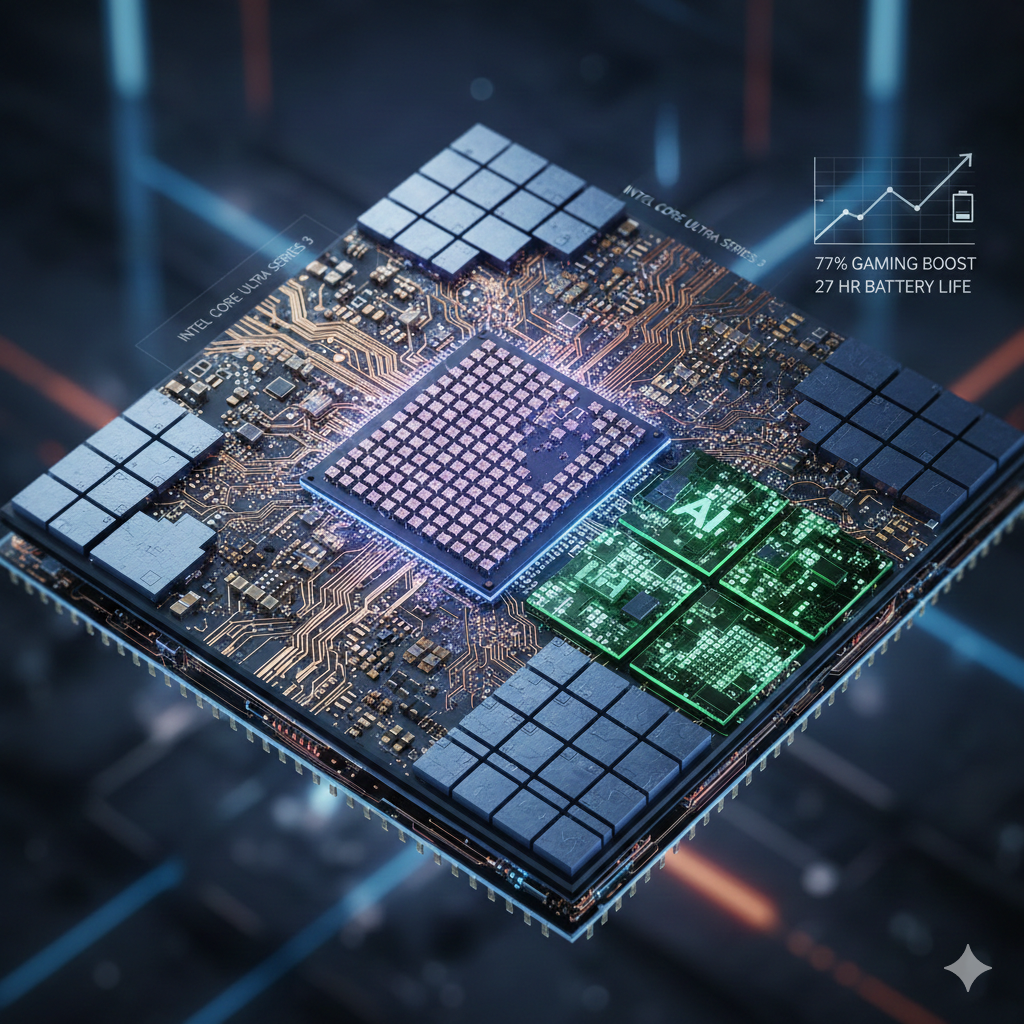
Intel’s Core Ultra Series 3 (Panther Lake), built on Intel’s 18A process, represents a major milestone in semiconductor manufacturing and computing performance. Here’s a breakdown of its significance and what makes it stand out:
1. The Intel 18A Process
- Intel’s 18A process is the latest and most advanced chip fabrication technology from Intel. The “A” stands for angstrom, which is a unit of measurement used to describe the size of transistors at a very small scale (1 angstrom = 1/10th of a nanometer). This process is expected to deliver much more dense and efficient transistors, enabling higher performance and energy efficiency compared to earlier technologies like Intel’s Intel 7 and Intel 4 processes.
- Key benefits of the 18A process:
- Smaller transistors that allow more cores and processing units to be integrated on a single chip.
- Better power efficiency due to advancements in transistor design, allowing for performance gains without significant power consumption increases.
- Higher frequency potential with better thermal performance, keeping the chip cooler during heavy tasks.
2. Performance Gains
- The Core Ultra Series 3 offers a 77% boost in gaming performance compared to Intel’s Lunar Lake (expected in 2024). This massive jump is partly thanks to improvements in the number and capability of cores and cache on the chip.
- It also leverages AI optimization to adapt and improve performance in real time, with increased support for parallel computing tasks. Games and other high-performance applications will run smoother with better graphical rendering, more efficient processing, and reduced system bottlenecks.
- The gaming performance boost is critical for Intel’s competition with AMD and Apple, both of whom have been rapidly improving their chips for gaming and content creation.
3. Battery Efficiency
- Despite the huge performance leap, Intel has ensured that the Core Ultra Series 3 offers up to 27 hours of battery life on ultra-portable laptops. This achievement is largely due to the power efficiency of the 18A process, which allows these chips to process more tasks per watt of power.
- This makes the chip highly appealing for ultra-thin laptops, hybrids, and 2-in-1 devices that need to strike a balance between power and longevity. Users can expect high-end performance without worrying about running out of battery after a few hours of use.
4. Efficiency Over Clock Speed
- The trend of efficiency over clock speed is now dominating the industry, and the 18A process exemplifies this. Unlike older generations of processors that relied heavily on higher GHz (gigahertz) for performance gains, the focus has shifted to efficiency. This involves creating chips that can handle more tasks in parallel, use less energy, and maintain higher performance without having to push the clock speeds too high, which would generate excessive heat and consume more power.
- Efficiency-focused design allows these processors to perform better under sustained load without causing battery drain or excessive thermal output. It’s more about optimized architecture than just clock speed, with multi-core performance and parallel computing being prioritized.
5. 45+ TOPS NPUs (Neural Processing Units)
- Laptops based on the Core Ultra Series 3 will now feature 45+ TOPS (Tera Operations Per Second) as a baseline for NPUs (Neural Processing Units). These are specialized hardware components designed to handle artificial intelligence (AI) workloads.
- With AI becoming a central part of modern computing (think voice assistants, image recognition, real-time translation), having an NPU on a laptop is becoming increasingly important. The 45+ TOPS baseline allows laptops to run AI tasks smoothly, without draining the main CPU, making the device more responsive and capable of handling complex tasks like real-time video editing, facial recognition, and more.
- This is a huge step toward AI-powered devices where the NPU accelerates machine learning tasks, offloading them from the main CPU and providing faster, more efficient processing.
6. How It Competes
- AMD and Apple have been steadily advancing in the processor space with AMD’s Ryzen 7000 series and Apple’s M2 chips, which already focus on delivering high performance with a strong emphasis on battery life.
- Intel’s Core Ultra Series 3 is designed to challenge these players with more balanced performance, better gaming performance, and cutting-edge power efficiency. Intel is betting that this shift toward efficient, multi-core computing, along with enhanced AI capabilities, will make it a preferred choice for a wide range of consumers—from gamers to professionals.
7. Market Impact
- Consumer laptops equipped with Intel’s 18A chips are likely to see a huge leap in performance. It will likely be the foundation for next-gen ultrabooks, gaming laptops, and content creation machines.
- Laptop makers will be able to provide better performance without compromising battery life, which is a key differentiator in the ultra-portable market.
- As the NPU standard becomes more commonplace, it will likely influence the development of new AI-powered features in both consumer and business applications. This could drive a greater demand for laptops that can handle intensive machine learning tasks and AI-based software.
In Summary:
The Intel Core Ultra Series 3 (Panther Lake), with its 18A process, offers an impressive combination of gaming performance, power efficiency, and AI capabilities. The 77% gaming performance boost, up to 27 hours of battery life, and the standard inclusion of 45+ TOPS NPUs signal a new era for consumer laptops, prioritizing efficiency over raw clock speed. This chip is set to challenge AMD and Apple’s dominance in the ultra-portable and gaming laptop markets.