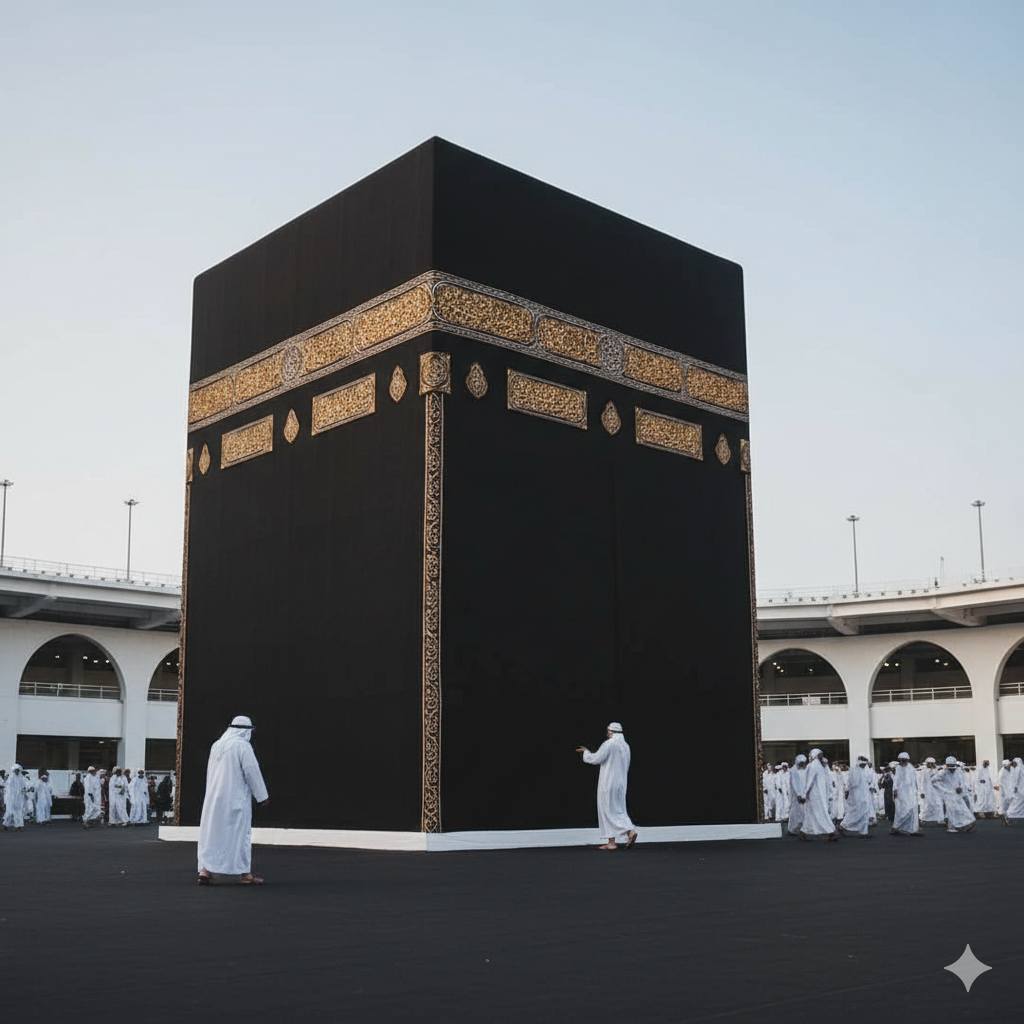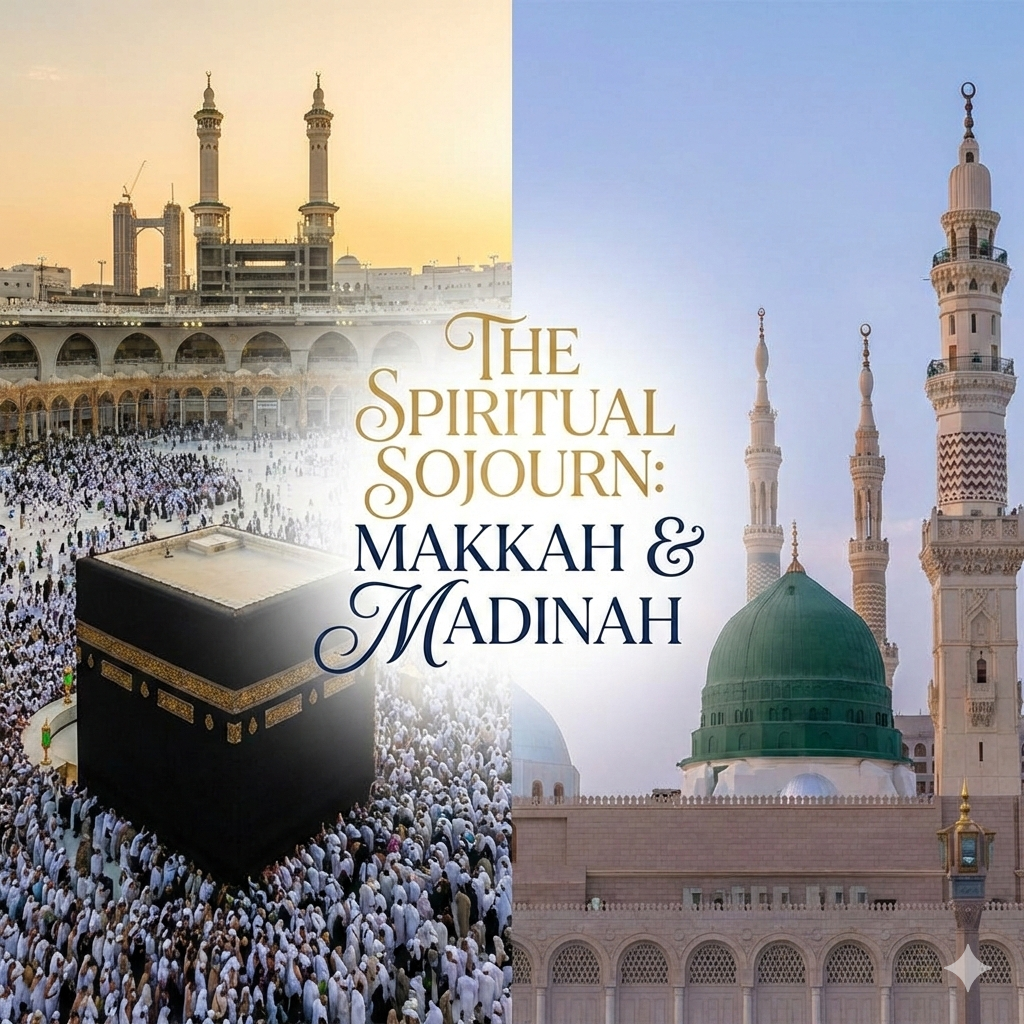
The journey to Makkah and Madinah is often described as a ‘recalibration of the soul.’ It is a physical journey—and a transformative life experience—that mirrors an internal one: moving from the intense, active submission of Makkah to the quiet, reflective gratitude of Madinah.”
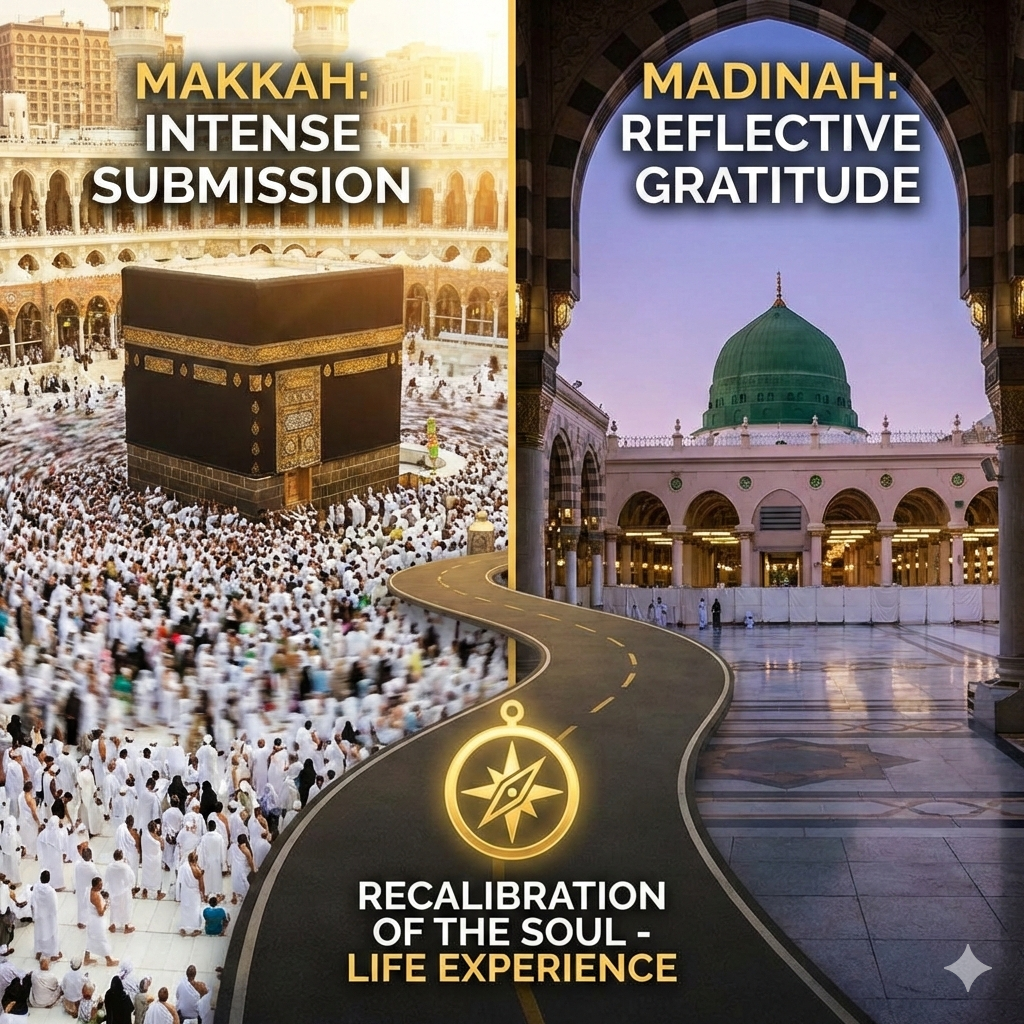
Here is a brief narrative of what that life experience feels like for a pilgrim:
The Makkah Experience: A Surge of Devotion
In Makkah, life revolves entirely around the Ka’bah. The experience is defined by a sense of urgency and awe.
- The First Sight: Entering Masjid al-Haram for the first time is often overwhelming. As you catch sight of the Ka’bah, the noise of the thousands around you seems to fade into a personal moment of realization. It is the physical “center” you have faced in prayer your entire life.
- The Physicality of Worship: Performing Tawaf (circling the Ka’bah) and Sa’i (walking between the hills) is physically demanding. You are part of a human tide, moving in unison. You lose your sense of individual ego as you realize that the person next to you, regardless of their language or wealth, is seeking the exact same mercy.
- The Energy: Makkah never sleeps. Whether it is 3:00 AM or midday, the white marble floors are cool underfoot, and the air is filled with the collective murmur of prayers. It is a place where you test your patience and find your strength.
The Madinah Experience: A Breath of Peace
The three-hour journey from Makkah to Madinah marks a profound shift in atmosphere. If Makkah is the “Majestic” (Jalal), Madinah is the “Beautiful” (Jamal).
- The Change in Pace: The moment you enter Madinah, the air feels softer. The “busy-ness” of Makkah is replaced by a profound tranquility (Sakina). The city moves at a slower, more deliberate pace.
- The Prophet’s Mosque: Walking into Masjid an-Nabawi feels like coming home. There is a deep emotional connection to the Prophet’s legacy here. Standing before the Rawdah—the area described as a garden from Paradise—is a moment of deep introspection and peace.
- The Historical Connection: Visiting sites like Mount Uhud or Masjid Quba isn’t just sightseeing; it’s a living history lesson. You stand where the early companions stood, making the stories of the Quran feel tangible and real.
The Lasting Impact
Returning from this journey, most people describe a feeling of “lightness.” The experience strips away the superficial layers of daily life, leaving you with:
- Perspective: Realizing how small your daily stresses are in the grander scheme of faith.
- Unity: A renewed love for the diversity of the global community.
- Purpose: A desire to carry the discipline of the five daily prayers and the kindness of the Madinan people back into your “regular” life.
10-Day Umrah & Madinah Itinerary
Phase 1: Makkah – The spiritual focus (Days 1–5)
- Day 1: Arrival & Umrah. Arrive in Jeddah, travel to Makkah. Perform your Umrah (Tawaf, Sa’i, and Halq/Taqsir) immediately while in the state of Ihram. Spend the night resting and reflecting at the Ka’bah.
- Day 2: Recovery & Devotion. Spend the day in Masjid al-Haram. Focus on the five daily prayers and perform an optional Tawaf during the quieter hours (usually late at night or mid-morning).
- Day 3: The Origins (Ziyarat). Visit Jabal al-Noor (Cave of Hira) and Jabal Thawr. Most people view these from the base, but if you are physically fit, you can hike Jabal al-Noor early in the morning to see where the first revelation descended.
- Day 4: Sites of Hajj. Visit Mina, Muzdalifah, and Plain of Arafat (Jabal al-Rahmah). Seeing these sites outside of the Hajj season provides a quiet space to contemplate the “Great Pilgrimage.”
- Day 5: Farewell Makkah. Perform a final Tawaf and prepare for the journey to Madinah via the High-Speed Haramain Train (a 2-hour smooth ride).
Phase 2: Madinah – The historical immersion (Days 6–10)
- Day 6: Greetings at the Prophet’s Mosque. Arrive and settle. Offer your Salam (greetings) to the Prophet (PBUH) at the Golden Gates and try to book a slot for the Rawdah via the Nusuk app.
- Day 7: The First Mosque. Visit Masjid Quba in the morning. (Sunnah: Perform wudu at your hotel and pray two units here to earn the reward of an Umrah).
- Day 8: Battlefields & Martyrs. Visit Mount Uhud and the Martyrs’ Cemetery. Reflect on the lessons of steadfastness from the Battle of Uhud.
- Day 9: The Seven Mosques & Qiblatayn. Visit Masjid al-Qiblatayn (where the direction of prayer was changed) and the site of the Battle of the Trench (Khandaq).
- Day 10: Departure. Spend your final hours in the serenity of Masjid an-Nabawi before heading to Madinah Airport for your flight home.
Deep Dive: Historical Sites in Madinah (Ziyarat)
Madinah is often called an “Open-Air Museum” of Islamic history. Here are the must-visit spots:
1. The Rawdah (The Garden of Paradise)
Located inside the Prophet’s Mosque, identified by green carpets (the rest of the mosque has red).
- Significance: The Prophet (PBUH) said, “Between my house and my pulpit is a garden from the gardens of Paradise.”
- Tip: You must book a specific time slot through the Nusuk App well in advance.
2. Mount Uhud
A massive red-stone mountain north of the city.
- Significance: The site of the second major battle in Islam. It houses the graves of 70 companions, including Hamzah ibn Abdul-Muttalib, the Prophet’s uncle.
- Experience: Climbing the “Archers’ Hill” (Jabal al-Rumat) gives you a clear view of the battlefield and helps you visualize the historical event.
3. Jannat al-Baqi
The main cemetery of Madinah, located right next to the Prophet’s Mosque.
- Significance: It is the resting place of many of the Prophet’s family members, wives, and thousands of his companions (Sahaba).
- Experience: It is usually open to men after Fajr or Asr prayers. Walking through it is a powerful reminder of the temporary nature of life.
4. Masjid al-Qiblatayn (The Mosque of the Two Qiblas)
- Significance: This is where the Prophet (PBUH) received the revelation to change the direction of prayer from Jerusalem (Al-Aqsa) to Makkah (The Ka’bah) mid-prayer.
Practical Tips for First-Timers
- The Nusuk App: This is your most important tool. You need it to book your Umrah permit and your appointment to enter the Rawdah in Madinah.
- Footwear: You will walk a lot. Bring high-quality, broken-in sandals. In the mosques, you’ll carry them in a bag, so bring a small drawstring bag.
- Hydration: Zamzam water is available everywhere. Drink plenty of it, as the climate is very dry.
- Peak Times: The mosques are most crowded from one hour before Adhan (call to prayer) until one hour after the prayer ends. If you want a quiet spot to read Quran, try going at 10:00 AM or 11:00 PM.