

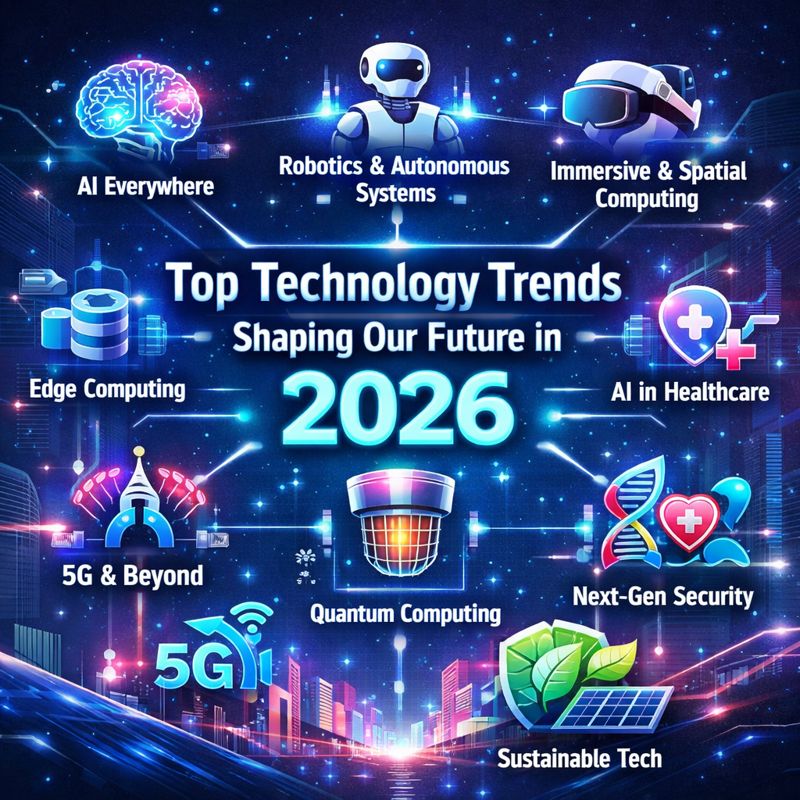
- 1. Artificial Intelligence (AI) Everywhere
- 2. Robotics & Autonomous Systems
- 3. Spatial Computing & Immersive Tech
- 4. Edge Computing & Distributed Intelligence
- 5. Cloud-Native & Hybrid IT
- 6. Quantum Computing on the Rise
- 7. AI in Healthcare & Biotech
- 8. Connectivity: 5G & Beyond
- 9. Next-Gen Security
- 10. Sustainable & Green Technology
1. Artificial Intelligence (AI) Everywhere
AI continues to be the biggest force shaping tech in 2026. Rather than just tools, AI systems are becoming core platforms deeply embedded in products, services, workflows, and automation across sectors like finance, healthcare, manufacturing, and education. Enterprise-level AI usage is rising sharply as companies move from experimentation to measurable business value.
Key developments:
- Generative and Adaptive AI that creates content, automates workflows, and learns over time. PT. Virtus Technology Indonesia
- AI agents that can autonomously plan, research, and execute tasks. Evident Aura
- AI-native operating systems that help with tasks like summarizing documents or managing workflows directly.
2. Robotics & Autonomous Systems
Robots — especially humanoid and autonomous machines — are moving from labs to real-world use. China and global companies are scaling production of humanoid robots for factories, logistics, and services. Drones and ground robots will also automate delivery, warehousing, and maintenance.
3. Spatial Computing & Immersive Tech
The immersive internet — combining AR (augmented reality), VR (virtual reality), and AI — is reshaping human interaction with digital content. These technologies will be used for:
- Remote collaboration and virtual meetings that feel more real.
- Immersive training and simulations in healthcare, aviation, and education.
- Enhanced retail and design experiences.
4. Edge Computing & Distributed Intelligence
Instead of relying purely on cloud data centers, edge computing brings processing closer to the device — improving speed, privacy, and responsiveness. This is vital for real-time AI on smartphones, cars, and industrial sensors.
5. Cloud-Native & Hybrid IT
Cloud computing remains essential, but it’s evolving:
- Hybrid and multi-cloud environments allow flexible deployment across private and public clouds.
- Cloud-native development and microservices speed up deployment and resilience.
- Real-time data streaming and intelligence improve decision-making and responsiveness.
6. Quantum Computing on the Rise
Quantum computing is reaching new milestones, with efforts to provide practical applications in drug discovery, materials science, and optimization problems. While still early for mass use, hybrid classical–quantum systems are emerging in enterprise use cases
7. AI in Healthcare & Biotech
AI is accelerating medical breakthroughs:
- Faster drug discovery
- Precision medicine tailored to a patient’s genetic profile
- Improved diagnostics and early disease detection models
This AI–biotech fusion could redefine treatment and healthcare workflows.
8. Connectivity: 5G & Beyond
Advanced connectivity like 5G is already enabling low-latency services and rapid data transmission, and preliminary 6G research is laying the groundwork for future ultra-fast, intelligent networks that further expand mobile, IoT, and real-time applications.
9. Next-Gen Security
As systems become more interconnected and AI-driven, security evolves too:
- AI-powered threat detection
- Zero trust architectures
- Post-quantum cryptography to prepare for future threats from quantum computing.
10. Sustainable & Green Technology
Tech is increasingly aligned with ecological goals:
- Green data centers
- AI-optimized resource management
- New materials for batteries, solar, and carbon capture
Technology becomes a key driver in meeting sustainability targets worldwide.
Summary: What This Means for 2026
The future of technology in 2026 is defined by AI integration everywhere, intelligent automation, immersive digital experiences, and smarter, more efficient infrastructure. These trends aren’t isolated — they converge to reshape industries, economies, and human lifestyles on a global scale.