

Genetic Technology Time Travel: Using Biotechnology to Resurrect the Past
The boundary between Technology science fiction and biological reality is blurring. From the controversial “de-extinction” of ancient predators to the practical preservation of endangered ferrets, scientists are now using biotechnology to move DNA across millennia. This “genetic Technology time travel” isn’t just about spectacle—it’s about survival, medicine, and ecological resilience.
The Dire Wolf Controversy: Engineering Ancient Traits Technology
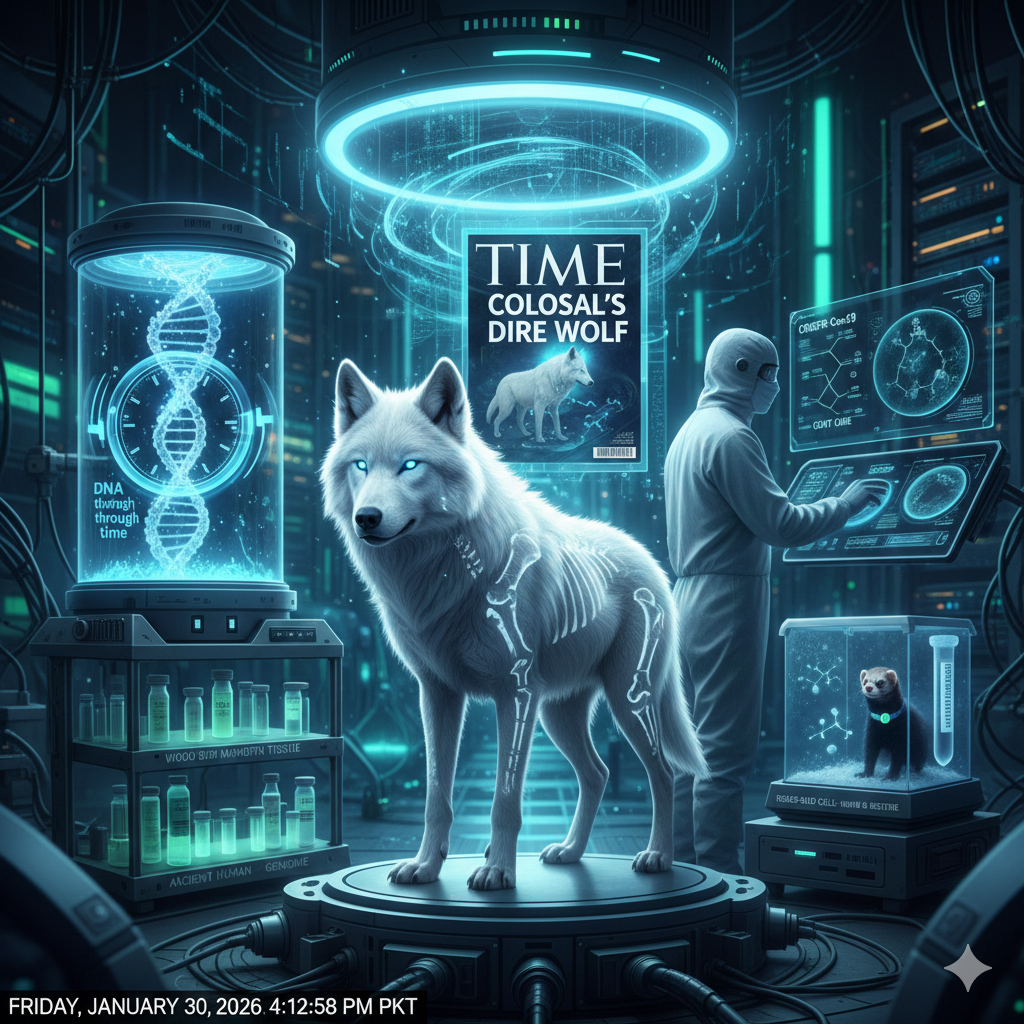
In early 2025, Colossal Biosciences sparked a global debate when they revealed a snow-white canid on the cover of Time magazine. While billed as a “dire wolf,” the scientific community was quick to offer a reality check.
The animal was actually a modern gray wolf, meticulously engineered using CRISPR technology to carry roughly 20 segments of DNA recovered from 10,000-year-old dire wolf remains. While not a pure resurrection, it represents a milestone in “functional de-extinction”—the ability to patch ancient biological traits into living species.
Genetic Libraries: From Dodos to Woolly Mammoths
The foundation of this work lies in massive genomic databases built from ancient biological “archives.” By using advanced sequencing technology to decode DNA from museum specimens and frozen remains, researchers have successfully mapped the blueprints of:
- The Dodo Bird: Recovered from preserved museum samples.
- The Woolly Mammoth: Extracted from soft tissue preserved in the Arctic tundra.
- Ancient Humans: Skeletons have provided a treasure trove of genetic material, allowing us to see how our ancestors evolved.
Medical Breakthroughs: “Resurrecting” Lost Enzymes
Genetic Technology time travel isn’t just for animals; it has profound implications for human health. Researchers at Georgia State University recently targeted a specific enzyme that humans and apes lost millions of years ago.
The absence of this enzyme is a primary cause of gout in modern humans. By using gene-editing technology to reintroduce this lost “ancestral” enzyme into human liver cells in a lab setting, scientists are paving the way for revolutionary gene therapies that could cure chronic inflammatory diseases.
Conservation 2.0: Saving the Black-Footed Ferret
While some projects focus on the distant past, the organization Revive & Restore is using cloning technology to solve modern extinction crises. The black-footed ferret, crippled by a dangerously small gene pool, is receiving a “genetic infusion” from the past.
The Resurrection Strategy:
- Cryopreservation: Scientists accessed cells frozen decades ago using deep-freeze storage technology.
- Cloning: These cells were used to create “new” ferrets from an older lineage.
- Genetic Diversity: These clones introduce thousands of variations no longer found in the wild population.
By breeding these “resurrected” relatives with the current wild population, scientists are using reproductive technology to artificially boost the species’ resilience against disease and environmental shifts.