

In the traditional world of software development, every line of code is a manual brick in a wall. Today, Generative Coding is changing the blueprint, allowing us to build entire structures with a single prompt. As we move through 2026, this technology is shifting from a “helpful assistant” to a core “creative partner.”
A New Partnership: Human Intent, Machine Execution of Generative Coding
Generative coding is the process of using AI models and predefined logic to automate the creation of software, digital art, and complex systems. Instead of getting bogged down in syntax, developers now act as “orchestrators.”
By feeding a system specific rules or natural language instructions, the machine handles the heavy lifting of writing the actual code. This isn’t about replacing the programmer; it’s about supercharging them.
Why Generative Coding is a Game Changer of Generative Coding
This shift is revolutionizing industries from game design to cybersecurity for four key reasons:
- Rapid Prototyping: Turn an idea into a functional Minimum Viable Product (MVP) in hours rather than weeks.
- Infinite Creativity: In gaming and art, procedural generation creates endless, unique worlds that no human could manually draw.
- Bridge the Talent Gap: It allows those with great ideas but limited technical “vocabulary” to build and innovate.
- Focus on Logic: Developers can spend more time on high-level architecture and user experience, leaving the repetitive “boilerplate” code to the AI.
Key Benefits at a Glance
| Feature | Impact |
| Speed | Build functional MVPs in hours, not weeks. |
| Scale | Create infinite digital worlds through procedural logic. |
| Access | Innovate without needing a deep technical vocabulary. |
| Focus | Offload boilerplate tasks to stay focused on high-level logic. |
Frequently Asked Questions about
- Is generative coding the same as AI coding?Mostly, yes. While generative coding can include older “procedural” rules, modern generative coding is largely powered by AI models (like LLMs) that understand and write code.
- Will it replace software developers?No. It changes the role from “writer” to “architect.” Humans are still needed to define the logic, ensure security, and oversee high-level design.
- Can non-coders use it?Absolutely. By using natural language prompts, people without formal training can now build websites, automate tasks, and create digital assets.
- Is the generated code secure?It depends. AI-generated code should always be reviewed by a human to ensure it follows security protocols and fits the specific needs of the project.
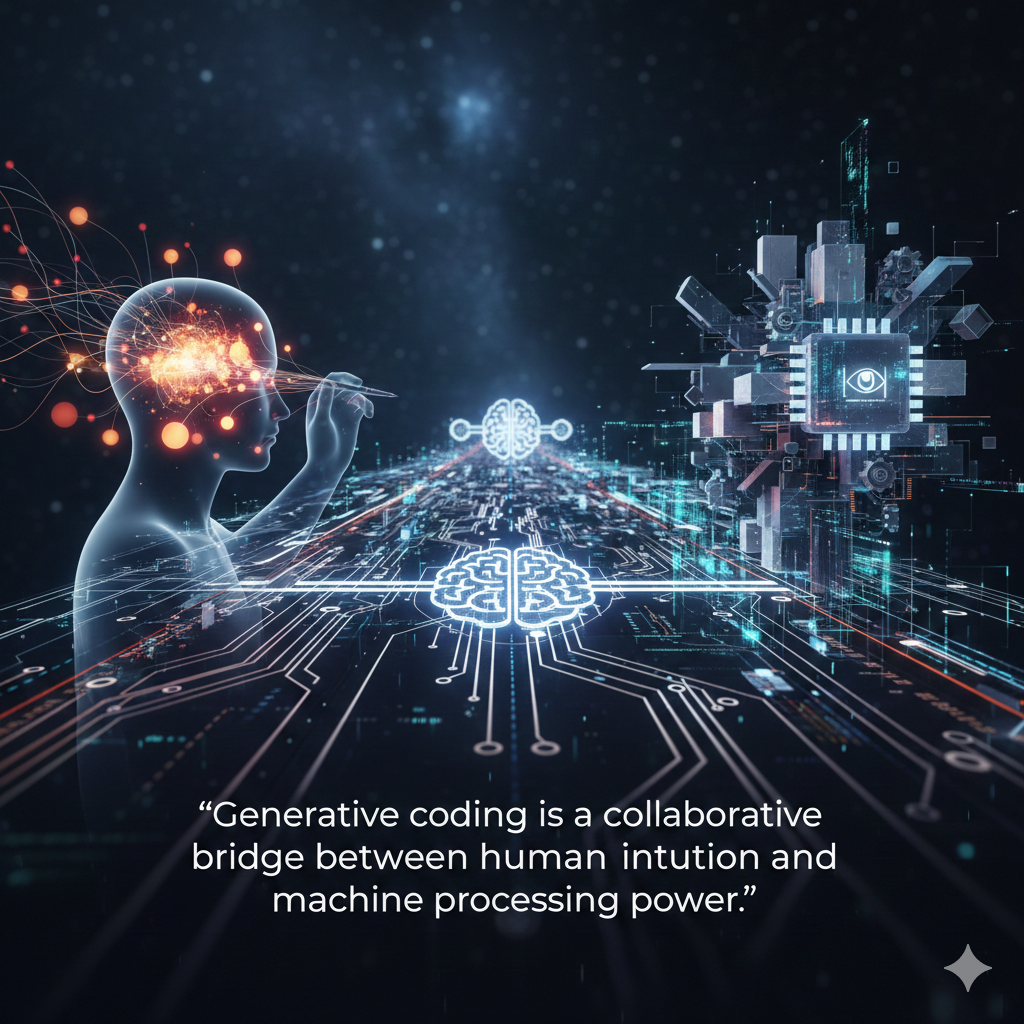
The Bottom Line: Generative coding is a collaborative bridge between human intuition and machine processing power.