

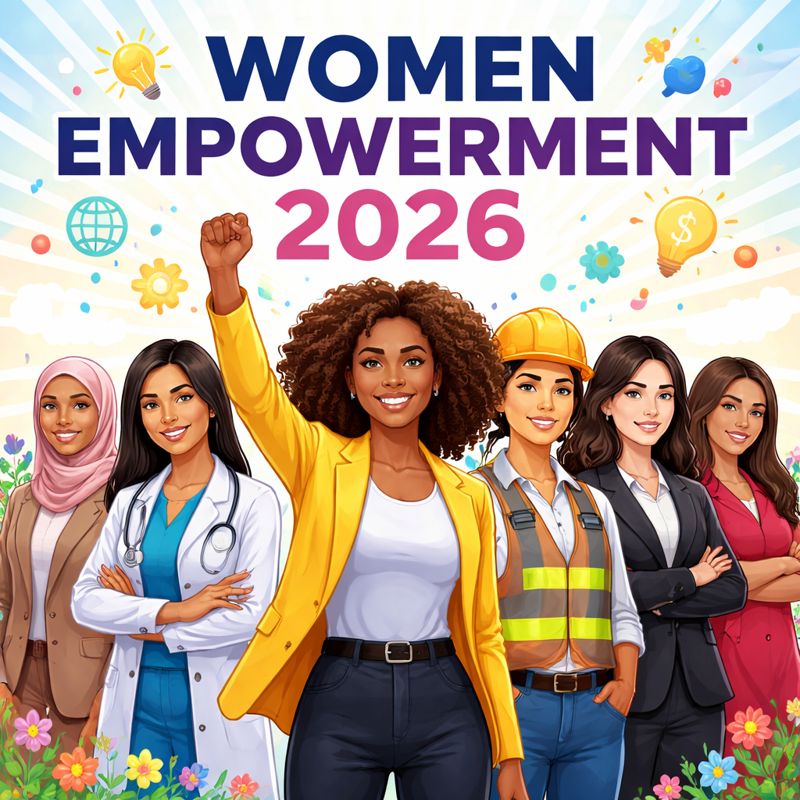
- Why 2026 Is a Defining Year for Women Empowerment
- Understanding the True Meaning of Women Empowerment
- Historical Perspective on Women’s Rights
- Key Milestones Achieved Before 2026
- How Digital Transformation Changed Empowerment
- Equal Access to Education in 2026
- Role of Technology in Women’s Learning
- Lifelong Learning and Skill Development
- Women in the Workforce and Leadership
- Female Entrepreneurship and Startups
- Financial Independence and Inclusion
- Women in Governance and Policy Making
- Breaking Cultural and Social Barriers
- The Role of Media and Storytelling
- Women in STEM and Tech Careers
- Digital Platforms as Empowerment Tools
- AI, Remote Work, and New Opportunities
- Gender Bias and Workplace Inequality
- Safety, Health, and Wellbeing Issues
- Bridging the Rural–Urban Gap
- What the Next Decade Looks Like
- How Individuals and Organizations Can Contribute
Why 2026 Is a Defining Year for Women Empowerment
The conversation around women empowerment has evolved significantly, and 2026 stands out as a pivotal year where action finally begins to match intention. Across the globe, societies are realizing that empowering women is not a “women-only” issue—it is a human issue, an economic issue, and a future-building necessity. When women rise, families thrive, communities grow stronger, and nations progress faster. This realization is shaping policies, businesses, and cultural narratives in powerful ways.
In 2026, women empowerment is no longer just about awareness campaigns or symbolic gestures. It is about measurable impact—equal pay, leadership representation, access to education, digital inclusion, and safety. Think of empowerment like planting a tree: earlier efforts were the seeds, but now we are finally seeing roots strengthen and branches spread. The real question is not whether women should be empowered, but how fast and how effectively we can make it happen.
Understanding the True Meaning of Women Empowerment
At its core, women empowerment means giving women the ability, freedom, and confidence to make decisions about their own lives. It is about choice—choosing education, choosing a career, choosing leadership, and choosing independence without fear or limitation. Empowerment does not mean overpowering others; rather, it means leveling the playing field so everyone gets a fair chance to succeed.
In 2026, empowerment also includes emotional, digital, financial, and political dimensions. A woman who has access to the internet, control over her finances, and a voice in decision-making spaces is truly empowered. Just like a bird needs both wings to fly, society needs both men and women equally empowered to soar toward progress.
The Evolution of Women Empowerment Over the Years
Historical Perspective on Women’s Rights
To understand where we are in 2026, we must look at where we started. Historically, women across many societies were denied basic rights such as education, property ownership, and voting. Their roles were confined to domestic spaces, often undervalued and unpaid. The journey toward empowerment has been long, marked by resilience, protests, and courageous voices that refused to be silenced.
From the suffrage movements of the early 20th century to global feminist waves, each generation of women pushed boundaries a little further. These movements were not just about rights on paper; they were about dignity, respect, and recognition. The struggles of the past laid the foundation for today’s opportunities, reminding us that empowerment is never given—it is earned and protected.
Key Milestones Achieved Before 2026
Before reaching 2026, several milestones reshaped the empowerment landscape. Women gained voting rights, entered higher education in large numbers, and broke barriers in professions once dominated by men. International frameworks like gender equality laws and workplace protections helped institutionalize empowerment efforts.
However, milestones are not finish lines. They are checkpoints. While progress has been significant, gaps still exist in pay equality, leadership representation, and social freedom. The year 2026 builds on these achievements while addressing unfinished business, ensuring that empowerment reaches women across all socioeconomic backgrounds.
How Digital Transformation Changed Empowerment
The digital revolution has been a game changer for women empowerment. Access to smartphones, social media, and online learning platforms has opened doors that were once firmly shut. Women can now learn new skills, start online businesses, and amplify their voices without traditional gatekeepers.
In 2026, digital empowerment is just as important as physical empowerment. A woman with internet access can connect globally, earn remotely, and advocate fearlessly. Technology has become both a tool and a bridge, narrowing gaps and creating opportunities that transcend geography.
Women Empowerment in Education
Equal Access to Education in 2026
Education remains the strongest pillar of women empowerment in 2026. When a girl is educated, generations benefit. Governments and organizations now recognize that investing in girls’ education is one of the highest-return investments possible. Schools, scholarships, and inclusive policies are increasingly designed to ensure no girl is left behind.
Yet, true equality goes beyond enrollment numbers. It includes safe learning environments, quality teaching, and encouragement to pursue diverse fields. Education empowers women with knowledge, confidence, and the ability to challenge injustice, making it the cornerstone of long-term societal change.
Role of Technology in Women’s Learning
Technology has revolutionized how women learn in 2026. Online courses, virtual classrooms, and mobile learning apps allow women to study at their own pace, even while managing family or work responsibilities. This flexibility is empowering, especially for women in conservative or remote areas.
Digital literacy also plays a crucial role. When women learn how to use technology effectively, they gain access to global knowledge and opportunities. Education is no longer confined to classrooms—it travels wherever a woman goes, right in her pocket.
Lifelong Learning and Skill Development
Empowerment does not stop after formal education. In 2026, lifelong learning is essential for women to stay relevant in rapidly changing job markets. Skill development programs focusing on leadership, entrepreneurship, and digital skills are empowering women to adapt and thrive.
Just like sharpening a tool makes it more effective, continuous learning sharpens a woman’s ability to navigate challenges. Empowerment grows stronger when learning becomes a lifelong habit rather than a one-time achievement.
Economic Empowerment of Women
Women in the Workforce and Leadership
Economic empowerment is a powerful driver of independence. In 2026, more women are entering the workforce and stepping into leadership roles than ever before. Companies are increasingly recognizing that gender-diverse leadership teams are more innovative, resilient, and profitable.
However, challenges such as wage gaps and glass ceilings still exist. Empowerment means not only allowing women into the room but also ensuring their voices are heard and valued. True leadership equality transforms workplaces into engines of inclusive growth.
Female Entrepreneurship and Startups
Women entrepreneurs are reshaping economies in 2026. From small home-based businesses to tech startups, women are creating solutions, generating employment, and driving innovation. Access to funding, mentorship, and networks is improving, making entrepreneurship more inclusive.
Starting a business is like building a ship while sailing it. Women entrepreneurs face storms, but empowerment gives them the skills and confidence to navigate rough waters and reach new horizons.
Financial Independence and Inclusion
Financial inclusion is central to women empowerment. In 2026, digital banking, mobile wallets, and financial literacy programs are helping women take control of their finances. Financial independence reduces vulnerability and increases decision-making power within households and communities.
When women control their money, they control their future. Financial empowerment transforms women from dependents into decision-makers, strengthening families and economies alike.
Social and Political Empowerment of Women
Women in Governance and Policy Making
Political empowerment ensures women have a say in decisions that affect their lives. In 2026, more women are holding political office, influencing policies on education, health, and equality. Representation matters because diverse voices create balanced solutions.
When women participate in governance, policies become more inclusive and compassionate. Political empowerment is not just about numbers—it is about impact and accountability.
Breaking Cultural and Social Barriers
Cultural norms often pose the toughest barriers to empowerment. In 2026, conversations around gender roles, consent, and equality are becoming more open and inclusive. Communities are slowly shifting from restrictive traditions toward supportive environments.
Breaking barriers is like breaking chains—once one link snaps, the rest follow. Social empowerment requires collective effort, education, and empathy.
The Role of Media and Storytelling
Media plays a crucial role in shaping perceptions. Positive representation of empowered women in films, news, and social media inspires change. Stories have the power to normalize equality and challenge stereotypes.
In 2026, storytelling is a tool of empowerment, amplifying women’s voices and redefining success beyond traditional norms.
Technology, Innovation, and Women Empowerment
Women in STEM and Tech Careers
Women’s participation in STEM fields is rising in 2026, driven by education initiatives and mentorship programs. Technology careers offer high growth and influence, making them critical for empowerment.
Encouraging girls to pursue STEM is like opening doors to future leadership in innovation-driven economies.
Digital Platforms as Empowerment Tools
Social media, freelancing platforms, and e-commerce sites empower women to earn, learn, and advocate independently. These platforms democratize opportunity and reduce entry barriers.
In 2026, a smartphone can be a workplace, a classroom, and a megaphone—all in one.
AI, Remote Work, and New Opportunities
AI and remote work are reshaping empowerment. Flexible work models allow women to balance personal and professional lives while accessing global opportunities.
Technology is not replacing women—it is enabling them to redefine work on their own terms.
Challenges to Women Empowerment in 2026
Gender Bias and Workplace Inequality
Despite progress, gender bias persists. Subtle discrimination and unequal opportunities still limit empowerment. Addressing these challenges requires policy enforcement and cultural change.
Safety, Health, and Wellbeing Issues
Safety remains a concern for women worldwide. Empowerment includes physical safety, mental health, and access to healthcare. A safe woman is an empowered woman.
Bridging the Rural–Urban Gap
Rural women often face greater barriers. Bridging this gap through education, technology, and infrastructure is essential for inclusive empowerment in 2026.
The Future of Women Empowerment Beyond 2026
What the Next Decade Looks Like
The future of women empowerment is promising yet demanding. Continued innovation, inclusive policies, and cultural shifts will shape the next decade.
How Individuals and Organizations Can Contribute
Empowerment is a shared responsibility. Supporting education, advocating equality, and challenging bias are actions everyone can take.
Conclusion: Why Women Empowerment Is Everyone’s Responsibility
Women empowerment in 2026 is not a destination—it is a journey. It is about creating a world where women can dream freely and achieve fearlessly. When women are empowered, societies flourish, economies grow, and futures become brighter. Empowering women is not just the right thing to do—it is the smart thing to do for humanity’s collective progress.