

It’s April 2026. The world doesn’t look that different through my kitchen window. The birds still argue about the birdfeeder, the trees are still waiting for spring, and the coffee smells the same.
But if I look down at my hands—specifically, the glass rectangle I’m holding—or if I think about the meeting I have at 10:00 AM, the last ten years haven’t just flown by; they’ve rewritten the playbook of how I interact with reality.
A decade ago, “tools” were passive. You used them. Today, in 2026, tools are active. They use you—your data, your patterns, your preferences—to shape a world tailored to you, sometimes before you’ve even realized you needed it shaped.
This is a reflection on that shift. Not from the perspective of a tech prophet, but from someone who has been watching the slow, inexorable migration from the analog edge to the automated core.
The Clunky Era: Making Tools Do Things
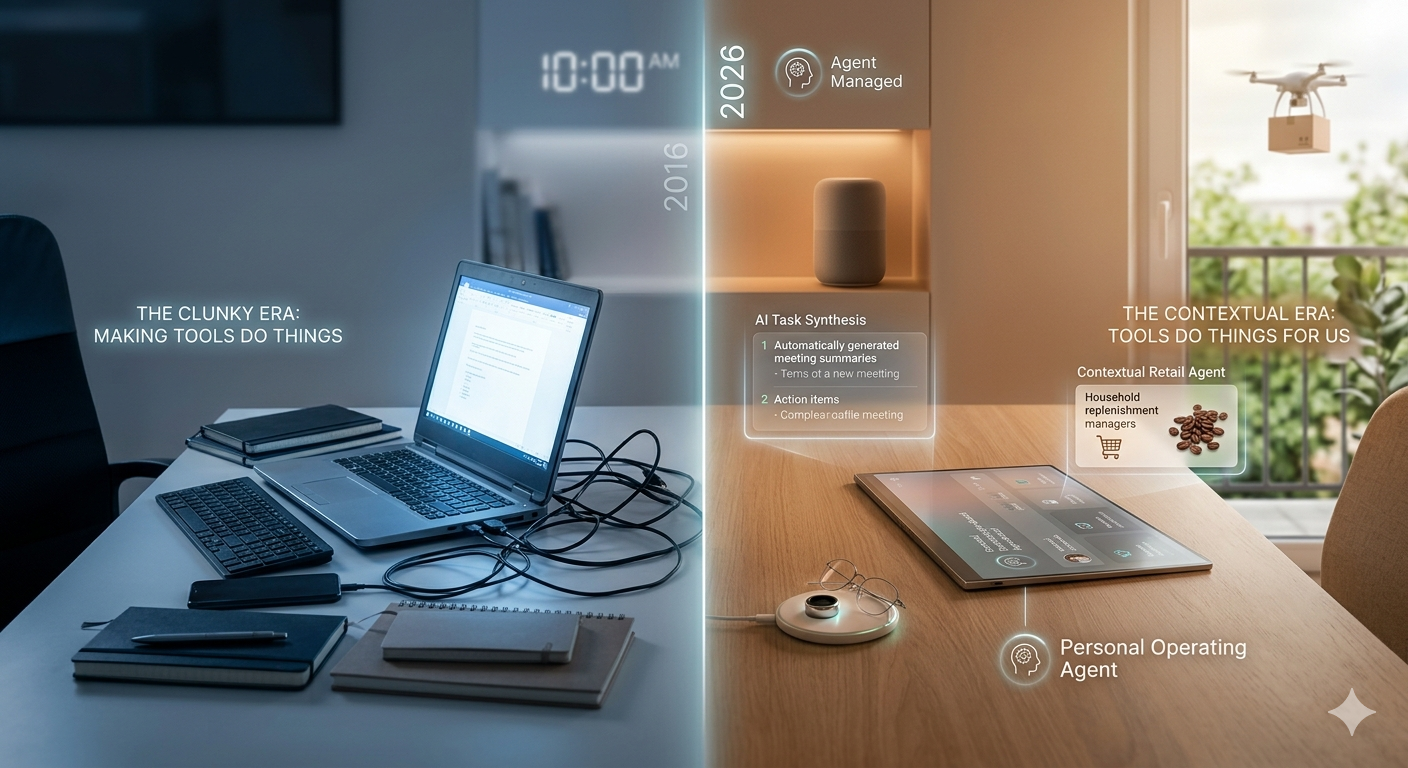
Let’s travel back. 2016. If I wanted to organize a team meeting, I had to be a conductor of digital noise. I emailed people to find their availability, manually created a calendar invite, manually set up a video link (that someone would inevitably lose), and then had to remember to record the meeting manually.
The tools were separate, noisy islands. We were the bridges. We spent most of our energy doing “meta-work”—the work of organizing the work. The frustration wasn’t that things didn’t work; it was that they required so much intention.
In our personal lives, automation was a fantasy reserved for high-end homes. A “smart home” was just a regular home where you could pay to control the lights with an app that occasionally crashed. Getting dinner meant manually searching a map app, manually scrolling reviews, manually calling the restaurant, or manually entering credit card details into a messy interface. It was a friction-filled existence.
The Transition: When Tools Started Talking to Each Other
Around 2019-2021, the friction began to smooth out. This was the era of Integration.
This is when the islands built docks. Suddenly, your calendar invite automatically generated the video link. Your document-sharing platform started suggesting people you might want to share the document with. The automation was still passive—it needed a “trigger”—but it was learning our connections.
The biggest shift, however, was the normalization of AI. It wasn’t a robot voice anymore; it was the “Smart Compose” suggesting the end of my email. It was the algorithm guessing what I wanted to watch next with frightening accuracy. We stopped treating AI as science fiction and started treating it as a slightly pushy editorial assistant.
The transition era taught us a new skill: Trust. We started trusting the machine to handle the routine, allowing us to focus on the rare. We moved from conductors to managers.
The Contextual Era: Where tools do things for us
Now, welcome back to today. April 2026.
I didn’t organize that 10:00 AM meeting. My Personal Operating Agent did. It knows my team’s project milestones, their individual productivity peaks (based on their historical work patterns, which they’ve shared), and my own concentration levels. It negotiated the time, generated the agenda, and synthesized the relevant background documents.
When the meeting starts, the Agent is present, not as a user, but as infrastructure. It doesn’t just record; it transcribes, summarizes, assigns action items based on verbal commitments, and—crucially—flags contextual contradictions between what someone says now and data presented in a document last year.
The tools are no longer separate; they are a seamless, ambient layer of intelligence.
1. The Death of Meta-Work
The most profound shift is the liquidation of routine. Data entry is gone. Basic scheduling is gone. Meeting minutes are gone. First-draft writing? That’s gone too. In 2026, our job isn’t to create; it’s to curate. We are editors of information, judges of creative direction, and stewards of strategy. The machine provides the clay; we provide the sculpture.
2. The Contextual Consumer
In my daily life, friction is nearly obsolete. I don’t “search” for products anymore. My local retail agent knows my household inventory. It knows when I’m running low on coffee beans or when my sneakers have exceeded their optimal mileage. It manages the logistics of replenishment, optimizing for price and carbon footprint.
3. The New Skillset: Prompt Engineering & Critical Skepticism
This decade didn’t make skills obsolete; it shifted the focus. In 2016, we learned coding languages. In 2026, we learn Prompt Engineering—the art of speaking the machine’s language to extract the desired outcome. The primary skill is no longer technical execution, but logical thinking and creative articulation.
But with this power comes a new requirement: Critical Skepticism. When tools become contextual, they become persuasive. When the algorithm is scary-good at predicting your needs, you must ask: Are these my needs, or are they the needs the machine has constructed for me?
Final Reflection
The decade from 2016 to 2026 was the story of tools moving from our hands to our minds. They used to be extensions of our muscles; now they are extensions of our consciousness.
The fear ten years ago was that automation would replace us. The reality in 2026 is that automation has displaced the boring parts of us. It has forced us to confront the question: When the machine can do the routine, what is left that is uniquely human?
The answer, it turns out, is the same as it was a decade ago: Empathy, creativity, moral judgment, and the capacity to ask the right questions. The difference is that now, we finally have the time to focus on them.