

- GPS: The Invisible Navigation System You Use Every Day
- Wi-Fi: The Silent Technology Connecting the World
- Artificial Intelligence Is Already Part of Your Daily Routine
- Contactless Payments: Faster, Safer, and Smarter Transactions
- Cloud Computing: The Invisible Storage Powering Modern Life
- QR Codes: Small Squares with Big Capabilities
- Biometric Authentication Is Replacing Traditional Passwords
- Smart Algorithms Personalize Your Digital Experience
- Internet of Things (IoT): Smart Devices Working Together
- Edge Computing: The Next Generation of Hidden Technology
- Why Hidden Technology Matters
- The Future of Invisible Technology
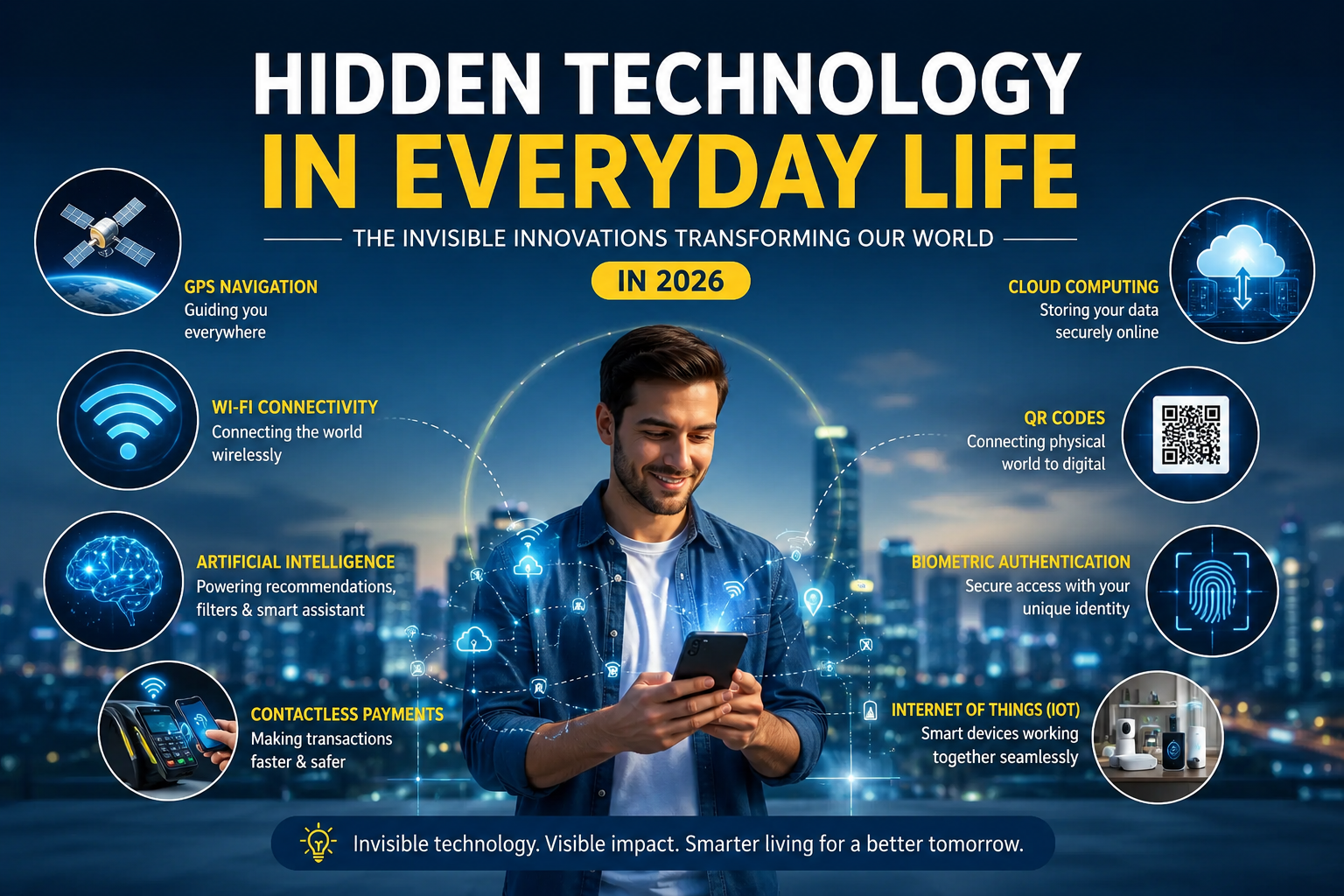
Technology is often associated with futuristic robots, artificial intelligence, or cutting-edge gadgets. However, the most impactful innovations are often the ones we never notice. Hidden technology works silently behind the scenes, making our lives faster, smarter, and more connected without demanding our attention.
From the moment you unlock your smartphone in the morning until you stream your favorite show before bed, invisible technologies are continuously working to improve your daily experience. Whether it’s navigating traffic with GPS, paying with your phone, or receiving personalized recommendations online, countless digital systems operate seamlessly in the background.
As digital transformation accelerates in 2026, understanding these hidden technologies helps us appreciate how deeply innovation is integrated into our everyday lives.
GPS: The Invisible Navigation System You Use Every Day
Global Positioning System (GPS) technology has become an essential part of modern life. Most people use it without realizing the complex infrastructure operating behind the scenes.
Every time you:
- Navigate using Google Maps
- Book a ride through Uber or Careem
- Track an online order
- Share your location
- Monitor your morning run
GPS satellites communicate with your smartphone to calculate your exact location within seconds.
Beyond personal navigation, GPS supports industries including logistics, aviation, agriculture, emergency response, shipping, construction, and public transportation. Without GPS, many services we rely on daily would simply stop functioning.
Wi-Fi: The Silent Technology Connecting the World
Imagine a day without Wi-Fi. Work, education, entertainment, and communication would come to a halt.
Wireless networking has become one of the most important hidden technologies in everyday life. Every home, office, shopping mall, airport, hospital, and university depends on Wi-Fi to keep people connected.
Behind every internet connection, sophisticated technologies manage:
- Wireless signal transmission
- Device authentication
- Data encryption
- Network routing
- Security protocols
- Bandwidth optimization
Modern Wi-Fi networks can support hundreds of connected devices simultaneously, allowing businesses and households to operate efficiently.
Artificial Intelligence Is Already Part of Your Daily Routine
When people hear “Artificial Intelligence,” they often think about ChatGPT, robots, or self-driving cars. In reality, AI has quietly become part of everyday life.
Artificial intelligence powers:
- Email spam filters
- Face recognition on smartphones
- Voice assistants
- Netflix recommendations
- Spotify playlists
- Google Search
- Shopping suggestions
- Language translation
- Photo organization
Machine learning algorithms analyze enormous amounts of data every second to understand user preferences and deliver personalized experiences.
Instead of replacing people, AI is enhancing productivity and simplifying routine tasks without most users ever noticing.
Contactless Payments: Faster, Safer, and Smarter Transactions
Digital payment technology has transformed the way people shop and manage money.
Today, purchasing groceries, paying restaurant bills, or fueling your car often takes just a few seconds.
Hidden technologies behind these transactions include:
- NFC (Near Field Communication)
- Tokenization
- End-to-end encryption
- Digital wallets
- QR code payments
- Mobile banking systems
Countries worldwide, including Pakistan through Raast, are rapidly adopting digital payment systems that improve convenience while reducing fraud.
Consumers simply tap their phone or scan a QR code, while advanced financial technologies securely process transactions in the background.
Cloud Computing: The Invisible Storage Powering Modern Life
Have you ever wondered where your photos, emails, documents, and videos are actually stored?
The answer is cloud computing.
Instead of relying solely on your device’s storage, cloud platforms securely save your information in massive data centers distributed around the world.
Popular cloud services include:
- Google Drive
- Microsoft OneDrive
- Dropbox
- Apple iCloud
- Google Photos
Cloud computing enables users to:
- Access files anywhere
- Automatically back up data
- Collaborate remotely
- Synchronize information across multiple devices
Without cloud infrastructure, many modern apps would not function as smoothly as they do today.
QR Codes: Small Squares with Big Capabilities
Only a few years ago, QR codes were rarely used. Today, they have become an essential part of modern business and consumer experiences.
You can now find QR codes in:
- Restaurants
- Retail stores
- Airports
- Banks
- Hospitals
- Hotels
- Business cards
- Product packaging
Businesses use QR technology to connect customers instantly with websites, payment systems, promotional campaigns, user manuals, and digital menus.
A simple scan creates an immediate bridge between physical products and digital information.
Biometric Authentication Is Replacing Traditional Passwords
Passwords are gradually becoming less common as biometric authentication becomes more reliable.
Today’s smartphones and banking applications increasingly rely on:
- Fingerprint recognition
- Facial recognition
- Iris scanning
- Voice authentication
These systems combine advanced sensors, artificial intelligence, encryption, and secure hardware to verify user identities within seconds.
Biometric security is also expanding into healthcare, government services, airports, border control, and digital identity verification.
Smart Algorithms Personalize Your Digital Experience
Have you ever wondered why your social media feed looks completely different from someone else’s?
The answer lies in recommendation algorithms.
Platforms like Facebook, Instagram, TikTok, YouTube, and LinkedIn continuously analyze your online behavior, including:
- Watch time
- Search history
- Clicks
- Comments
- Likes
- Shares
- Interests
These algorithms determine which posts, advertisements, videos, and products appear on your screen.
For businesses, understanding these algorithms has become essential for successful digital marketing and customer engagement.
Internet of Things (IoT): Smart Devices Working Together
The Internet of Things (IoT) refers to billions of connected devices that communicate through the internet.
Examples include:
- Smart TVs
- Smartwatches
- Fitness trackers
- Home security cameras
- Smart lighting
- Smart refrigerators
- Connected vehicles
- Voice assistants
These devices automatically collect information, receive software updates, monitor performance, and automate everyday tasks.
IoT is making homes smarter, businesses more efficient, and cities increasingly connected.
Edge Computing: The Next Generation of Hidden Technology
One of the fastest-growing technologies in 2026 is edge computing.
Unlike traditional cloud computing, which processes information in centralized data centers, edge computing processes data much closer to where it is generated.
This provides several advantages:
- Faster processing speeds
- Lower latency
- Improved cybersecurity
- Reduced bandwidth usage
- Better performance for AI applications
- More reliable IoT devices
Edge computing is already being used in autonomous vehicles, healthcare monitoring, industrial automation, smart manufacturing, and smart cities.
Why Hidden Technology Matters
Hidden technology has quietly become the foundation of our digital lives. While these systems often go unnoticed, they influence nearly every aspect of modern society.
For individuals, invisible technology provides:
- Greater convenience
- Faster communication
- Enhanced security
- Better entertainment
- Smarter transportation
- Personalized online experiences
For businesses, these technologies enable:
- Improved customer experiences
- Increased operational efficiency
- Better cybersecurity
- Data-driven decision-making
- Digital transformation
- Sustainable growth
As technology becomes increasingly integrated into everyday life, understanding these invisible innovations helps us make informed decisions about privacy, security, and digital adoption.
The Future of Invisible Technology
The future of technology is not about making devices more noticeable—it is about making them disappear into the background.
Emerging innovations such as ambient computing, advanced AI assistants, digital identity systems, smart automation, and edge computing will continue to make technology more seamless than ever before.
Soon, many everyday tasks will happen automatically without requiring manual input, allowing people to focus more on creativity, productivity, and meaningful interactions.
Hidden technology is not replacing human life—it is enhancing it through intelligent, secure, and connected digital experiences.
As we move further into 2026 and beyond, the greatest innovations may not be the ones we can see, but the ones quietly working behind the scenes to make our world smarter every single day.
Frequently Asked Questions (FAQs)
What is hidden technology?
Hidden technology refers to digital systems and innovations that operate in the background without requiring direct user interaction, such as AI algorithms, GPS, cloud computing, and biometric authentication.
Why is hidden technology important?
It improves convenience, security, productivity, and connectivity while enabling many of the digital services people use every day.
What are examples of hidden technology?
Examples include GPS navigation, Wi-Fi, cloud computing, AI recommendations, QR codes, biometric authentication, contactless payments, IoT devices, and edge computing.
How does AI work behind the scenes?
AI analyzes user behavior and data patterns to personalize recommendations, improve search results, detect fraud, filter spam, and automate routine tasks.
Hidden technology is the invisible engine driving modern life. From AI-powered recommendations and cloud computing to GPS navigation and smart devices, these innovations work quietly in the background to simplify everyday tasks. As digital transformation continues, invisible technologies will become even more integrated into our lives, delivering smarter, safer, and more personalized experiences. Understanding these technologies helps individuals and businesses stay prepared for a future where the most powerful innovations are the ones we hardly notice.